J1939 Protocol for commercial Vehicles
12 June 2026
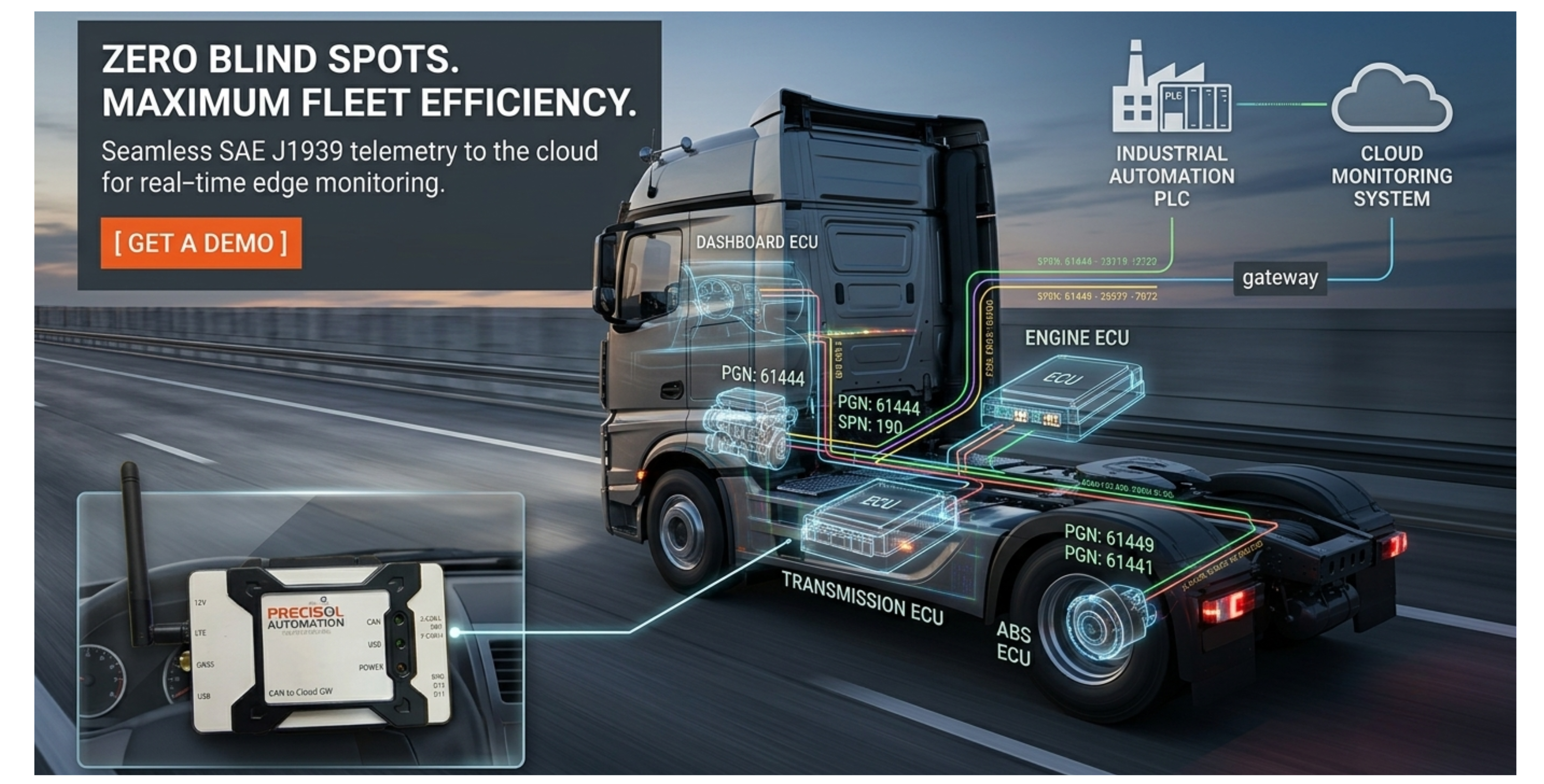
Demystifying the SAE J1939 Protocol: The Digital Backbone of Commercial Vehicles
Imagine standing next to a modern heavy-duty commercial truck. From the outside, it looks like a classic marvel of mechanical engineering—a roaring diesel engine, heavy-duty axles, and structural steel built to haul tons of freight across vast continents. But beneath that rugged, metallic exterior lies a silent, incredibly sophisticated digital nervous system. Today’s commercial vehicles are effectively rolling data centers, where dozens of Electronic Control Units (ECUs) continuously communicate to manage everything from engine timing and emissions to braking systems and transmission shifts.
At the heart of this complex, high-speed orchestration sits a single, standardized communication framework: the SAE J1939 protocol. Developed by the Society of Automotive Engineers (SAE), J1939 has become the global benchmark for standardizing electronic communication across heavy-duty commercial vehicles, transit buses, agricultural machinery, military systems, and maritime vessels. Understanding how this protocol operates is crucial for fleet managers, telematics engineers, and industrial automation professionals looking to harness vehicle data for predictive maintenance, efficiency, and real-time diagnostics.
The Evolution: Why Do We Need J1939?
Before the widespread adoption of standardized communication protocols, automotive electronics resembled a digital Tower of Babel. Every vehicle manufacturer—and often individual component suppliers—used proprietary wiring systems and unique software languages. An engine built by one company could not easily communicate with a transmission built by another without complex, custom-engineered translation hardware.
As commercial vehicles grew more complex, driven by strict regulatory mandates for emissions control and active safety features, this fragmented approach became unsustainable. The industry needed a uniform framework built on top of the robust Controller Area Network (CAN bus) architecture.
Thus, the SAE J1939 protocol was born. It established a standard, open "language" that allowed components from completely different manufacturers to plug into the same network, immediately understand one another, and operate in perfect harmony. Without this standard, today's advanced fleet telematics, remote diagnostics, and predictive maintenance algorithms would be virtually impossible to implement efficiently on a multi-brand fleet.
How the J1939 Protocol Works: Under the Hood
The SAE J1939 protocol is built directly on top of CAN bus technology, specifically utilizing the CAN 2.0B specification. While the underlying CAN bus defines how individual electrical bits are formatted and sent over a physical twisted pair of wires (the physical and data link layers), J1939 acts as the higher-layer application protocol. It defines exactly what those bits mean.
To understand its inner workings, it helps to examine its unique addressing and messaging architecture, which sets it apart from standard passenger car OBD-II networks:
- The 29-Bit Identifier: Unlike standard CAN networks that use an 11-bit identifier, J1939 mandates a 29-bit identifier to provide the structural depth required for commercial machinery. This identifier is split into several sub-fields, ensuring that every message carries critical metadata natively:
- Priority (3 bits): Dictates which message wins access to the network first. Critical safety data like braking commands receive high priority (0), while routine diagnostic data receives a lower priority (7).
- Parameter Group Number (PGN): A core concept in J1939. A PGN is a unique 18-bit value that identifies the specific type of message being transmitted, such as engine temperature, fuel economy, or wheel speed.
- Source Address (8 bits): Explicitly identifies which component sent the message (e.g., Address 0 is traditionally reserved for the Engine, while Address 3 is the Transmission).
- Suspect Parameter Numbers (SPNs): If a PGN defines a complete package of data, the Suspect Parameter Numbers (SPNs) define the individual metrics packaged inside it. For example, PGN 61444 represents "Electronic Engine Controller 1." Inside that single PGN package, you will find multiple SPNs, such as SPN 190 (Engine Speed) and SPN 513 (Actual Engine Percent Torque).
This standard architecture allows any telematics device or diagnostic tool to instantly extract precise data values without needing a proprietary decoding sheet.
| Standard Component | PGN Example | SPN Included | Data Parameter |
|---|---|---|---|
| Engine ECU | 61444 (EEC1) | 190 | Engine Speed (RPM) |
| Engine ECU | 61444 (EEC1) | 513 | Actual Engine Percent Torque |
| Cruise Control / Vehicle Speed | 65265 (CCVS) | 84 | Wheel-Based Vehicle Speed |
| Engine Fluid Level / Pressure | 65263 (EFL-P1) | 100 | Engine Oil Pressure |
The Practical Benefits: Why J1939 Dominates the Fleet World
The standardization brought by the J1939 protocol offers undeniable advantages across the entire automotive, logistical, and industrial ecosystem:
- Plug-and-Play Interoperability: Component suppliers can design parts with total confidence that they will integrate seamlessly into any major commercial truck chassis.
- Advanced Diagnostics and Telematics: Because fault codes (Diagnostic Trouble Codes, or DTCs) are standardized via J1939, fleet managers can monitor cross-brand fleets remotely using uniform software. They instantly know if a truck in another state has an issue with its aftertreatment system or oil pressure.
- Reduced Wiring Complexity: Instead of running individual dedicated wires from every sensor to every gauge or dashboard display, a single twisted-pair J1939 cable connects all components, radically reducing vehicle weight and potential points of physical failure.
Bridging the Gap: Integrating J1939 with Industrial Automation
While J1939 is the undisputed king of the commercial vehicle world, an interesting challenge arises when this data needs to cross over into other environments—such as stationary power generation plants, factory automation systems, and smart warehouse docking systems. Industrial automation plants typically do not speak J1939; instead, they rely on protocols like Modbus, Profinet, or EtherNet/IP.
This is where hardware protocol translation becomes essential. Bridging the gap between a vehicle network and an industrial control room requires heavy-duty, reliable, and intelligent hardware capable of reading high-speed J1939 traffic, isolating relevant data points, and converting them into industrial protocols in real time.
Supercharge Your Vehicle Integration with Precisol Automation
Navigating the nuances of heavy-duty vehicle data extraction requires specialized hardware expertise. Whether you are building an automated testing rig, integrating a commercial truck engine into a stationary industrial application, or implementing a custom fleet data logging matrix, seamless communication is paramount.
Precisol Automation delivers the precise bridging technology required to make these complex environments interact flawlessly. Designed specifically to tackle tough protocol translation challenges, the Precisol CAN Bus Gateway serves as an intelligent, high-performance bridge between mobile machinery and industrial networks. It effortlessly decodes J1939 protocols and maps them directly to the control systems your operations rely on.
Don't let incompatible protocols stall your technical innovation or data visibility. Discover how Precisol can simplify your hardware architecture and streamline your data streams.