Industrial Data Acquisition Challenges & IoT Gateway Solutions
13 June 2026
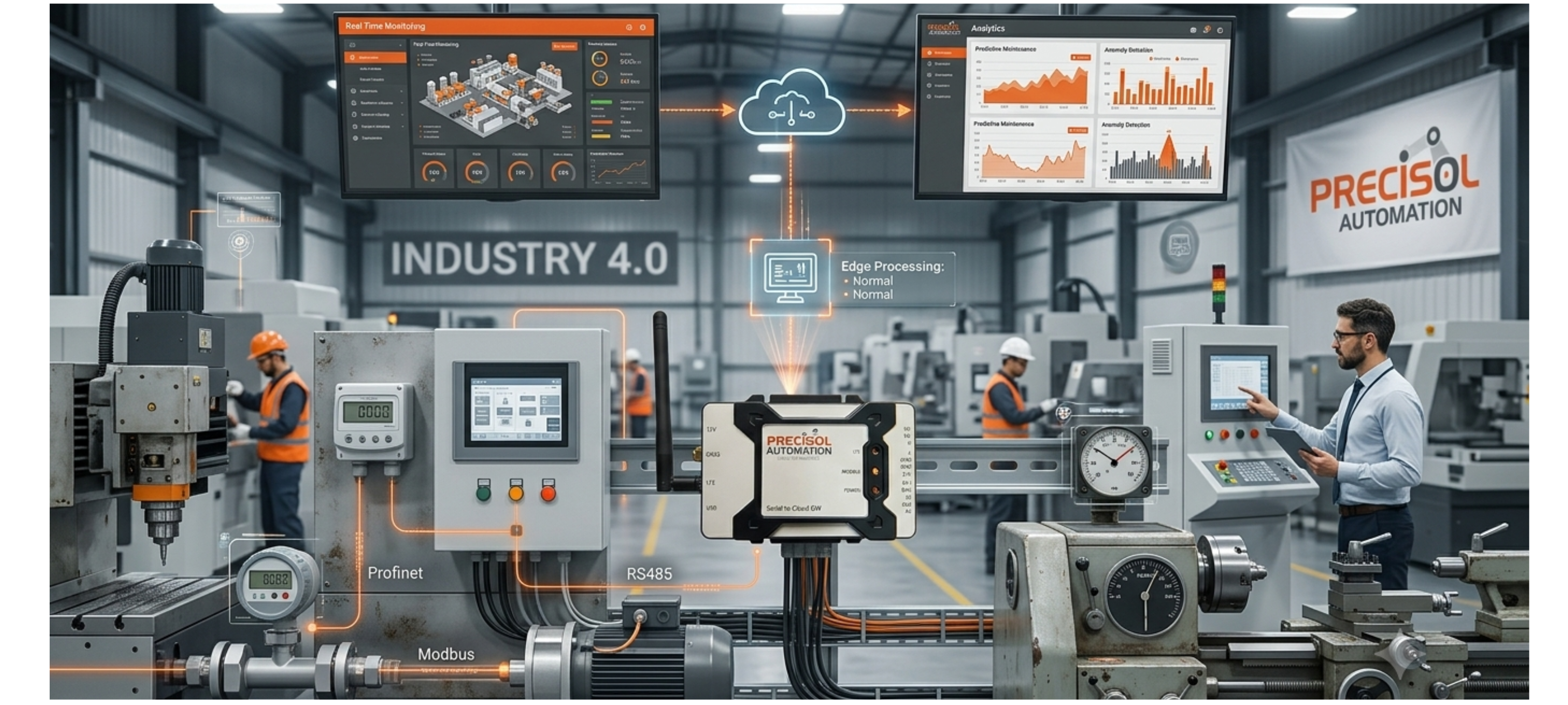
Challenges in Industrial Data Acquisition and How IoT Gateways Solve Them
We live in an era dominated by data-driven intelligence. From e-commerce recommendations to predictive health tracking, information is captured, processed, and utilized in real time. Yet, when you step inside a modern factory, a processing plant, or a heavy industrial facility, the flow of information frequently hits a wall. Industrial environments are goldmines of potentially transformative data, generated by thousands of sensors, flowmeters, robotic arms, and legacy machines. However, extracting that data and turning it into actionable intelligence remains one of the steepest operational hurdles companies face today.
This challenge is known as industrial data acquisition. In theory, it sounds simple: connect a machine to a network and read its outputs. In practice, the industrial floor is a chaotic, fragmented ecosystem of mismatched technology, hostile electrical environments, and incompatible communications protocol architectures. Fortunately, a technological bridge has emerged to conquer these complexities: the Industrial IoT gateway. Let’s break down the hidden challenges of industrial data harvesting and explore how smart gateway solutions are changing the game.
The Architectural Headaches of Industrial Data Acquisition
To understand why industrial data acquisition is so difficult, one must look at the historical evolution of plant floor operations. Unlike modern cloud environments built on uniform open standards, factories are built to last for decades. This durability creates an evolutionary bottleneck characterized by several deep challenges:
- The Protocol Tower of Babel (Data Silos) A typical manufacturing environment consists of a wide range of industrial devices, sensors, controllers, and machinery that communicate using different protocols and standards. As facilities evolve over time, newer systems are often deployed alongside legacy equipment, creating a complex network of disconnected data sources. Bridging these communication gaps is essential for achieving seamless connectivity, real-time visibility, and successful Industrial IoT (IIoT) implementation. None of these systems natively understand each other, and none of them can talk directly to an enterprise Cloud application using MQTT or HTTP. Breaking these data silos requires constant, real-time translation.
- Managing Growing Volumes of Industrial Data As more sensors, controllers, and connected devices are deployed across industrial operations, the volume of generated data continues to grow rapidly. Sending every data point directly to cloud platforms can increase bandwidth usage, storage costs, and processing overhead. Organizations need smarter ways to filter, process, and transmit only relevant information, enabling faster decision-making while optimizing communication and cloud resources.
- Legacy Machinery vs. Modern Analytics A multi-million-dollar CNC machine or heavy hydraulic press purchased twenty years ago might still function flawlessly at its mechanical task. However, it lacks an ethernet port, embedded internet security, or modern software APIs. Replacing these massive investments purely to harvest data is financially impossible; operations must find a way to retroactively extract data from legacy devices.
How IoT Gateways Solve the Data Acquisition Puzzle
An Industrial IoT Gateway acts as a physical and digital translator stationed directly between operational technology (OT) on the plant floor and information technology (IT) in the cloud or corporate data center. Instead of forcing an overhaul of your existing infrastructure, an intelligent gateway fits seamlessly into your current layout, resolving bottlenecks through several core mechanisms:
| Data Challenge | IoT Gateway Solution | Operational Benefit |
|---|---|---|
| Protocol Mismatch (Modbus, Profinet, CAN) | Multi-protocol Translation Engine | Consolidates all plant machinery into a single language. |
| Bandwidth Overload & Cloud Costs | Edge Computing and Local Filtering | Reduces data transmission by sending only anomalies/changes. |
| Security Vulnerabilities | Firewalls, Encryption, and Network Isolation | Protects critical machinery from external cyber threats. |
| Legacy Non-Digital Machines | Analog/Digital I/O and Serial Interfacing | Extends the operational lifespan of older equipment. |
- Seamless Protocol Conversion A smart edge gateway is multi-lingual by design. It can listen to Modbus, read CAN bus traffic, poll Profinet data streams simultaneously, and translate those diverse fields into universally accepted formats like JSON or OPC UA. This consolidated data is then securely packaged and pushed via MQTT or WebSockets to cloud platforms or local SCADA systems.
- Edge Computing: Reducing the Noise A single industrial sensor can generate hundreds of data points every second. If you stream every single repetitive data point directly to the cloud, your network bandwidth will bottleneck, and your cloud storage bills will skyrocket. IoT gateways employ edge computing to process data locally. They filter out the "noise" (e.g., repeating normal temperature readings) and only transmit meaningful changes, anomalies, or aggregated averages.
The Strategic Advantage of Unlocked Data
When an IoT gateway successfully mitigates data acquisition challenges, it unlocks profound business outcomes. Companies transition from reactive operations—repairing a broken machine after an expensive line stoppage—to predictive maintenance strategies, where the gateway flags subtle deviations in vibration or temperature before a breakdown happens. Overall Equipment Effectiveness (OEE) can be monitored continuously, and energy usage can be optimized dynamically across the entire facility based on live operational loads.
Empower Your Digital Transformation with Precisol Automation
Overcoming the technical friction of industrial data acquisition requires more than generic hardware; it demands specialized industrial engineering expertise. Every plant layout presents unique combinations of legacy hardware, custom protocols, and environmental challenges that off-the-shelf consumer tech cannot handle.
Precisol Automation specializes in bridging these demanding operational gaps. With a deep heritage in hardware design and protocol optimization, Precisol provides highly reliable, versatile, and industrial-grade communication solutions engineered to thrive in tough environments. The Precisol IoT Gateway portfolio is purpose-built to aggregate messy field data, handle complex protocol conversion tasks, and establish a secure pipeline between your machinery and your analytics applications.
Don't let legacy infrastructure or protocol silos blind your operational strategies. Take control of your factory metrics and optimize your system performance today. Partner with the experts who understand industrial communication inside and out.