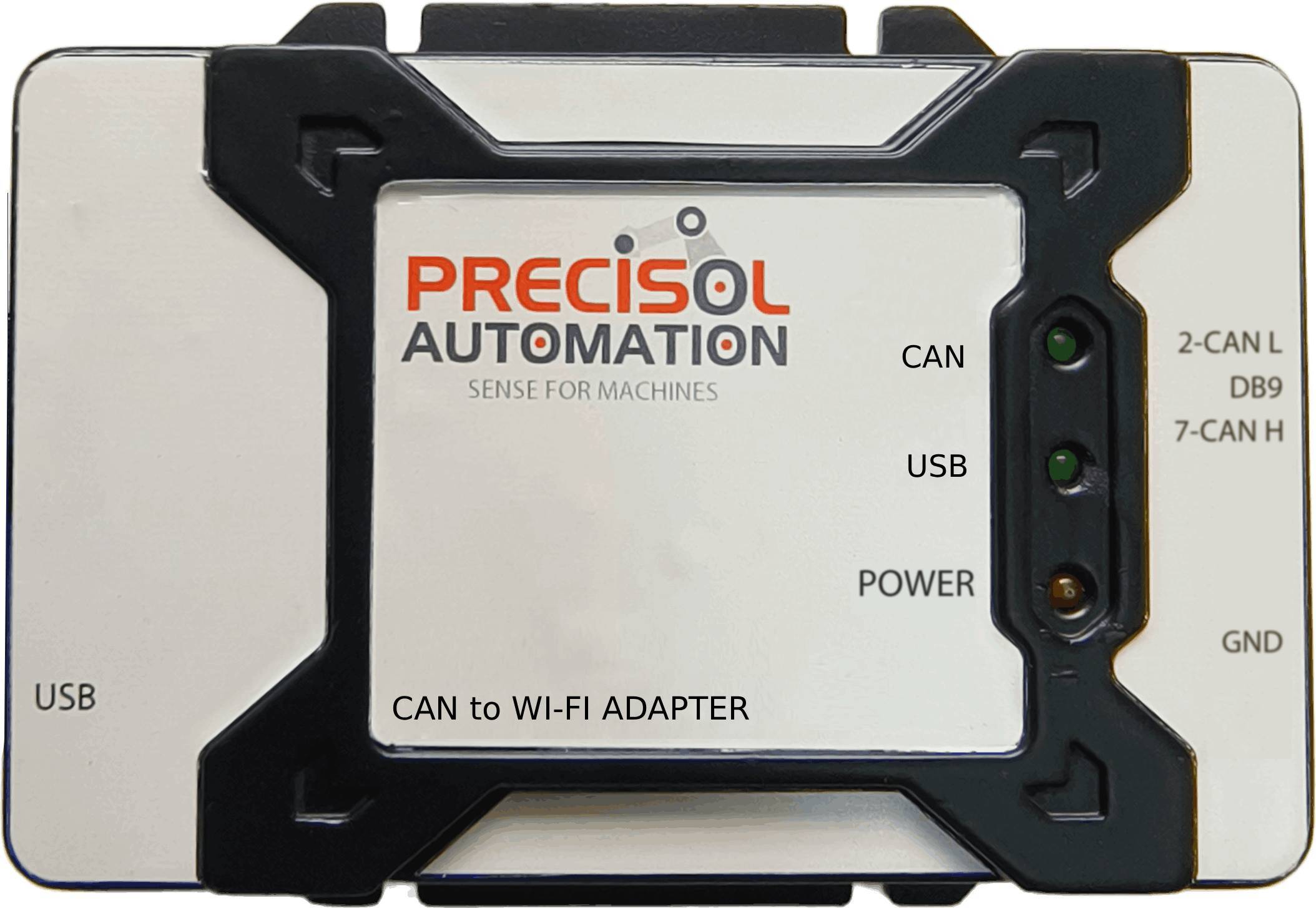
CAN to Wi-Fi Adapter

CAN to Wi-Fi Adapter

CAN to Wi-Fi Adapter


Our CAN to Wi-Fi Adapter is designed to provide seamless wireless connectivity for CAN bus–based systems. This gateway allows users to access and monitor CAN data remotely over a Wi-Fi network, making it ideal for applications where wired access is difficult or impractical. It enables reliable bi-directional communication between CAN networks and wireless devices, acting as a bridge for real-time data exchange.

The adapter features a single high-speed CAN interface with configurable baud rate support, allowing compatibility with a wide range of vehicles, machines, and control systems. It is suitable for wireless CAN monitoring in off-highway vehicles, mining equipment, industrial machinery, and automation systems. The device can be powered directly from standard 12V or 24V DC power sources, ensuring easy integration into existing electrical systems. A built-in status indicator provides quick visibility for device operation.

With integrated Wi-Fi connectivity, the CAN to Wi-Fi Adapter supports both Station mode and Access Point mode, operating across 2.4GHz frequency bands. CAN data from connected systems can be accessed using laptops, tablets, or transmitted to servers for monitoring, diagnostics, and analysis. This makes the CAN Wi-Fi adapter a flexible solution for remote access, testing, and monitoring of CAN-based applications.


Highlights

Protocol Supported

The CAN to Wi-Fi Adapter supports standard CAN communication protocols including CAN 2.0A and CAN 2.0B. It is compatible with OBD-II based CAN networks as well as custom OEM CAN frames, making it suitable for passenger vehicles, commercial vehicles, EVs, and industrial CAN applications.

Works with Bus Master

CAN to Wi-Fi converter works extensively with BUS MASTER, an open-source software tool to simulate, analyze, and test CAN bus. It is used to send or receive data from the server. An ideal tool for CAN-based development and testing. It helps engineers easily validate and debug CAN communication during development.

Easy Installation

Built with a plug-and-play design, the converter ensures quick and straightforward installation without complex configuration. With support for both 12V and 24V DC power input, the device can be directly powered from standard vehicle or machine batteries. This allows fast deployment in industrial applications.

Typical Application


With its compact design and wi-fi connectivity, the gateway is ideally suitable for telematics and predictive maintenance of a vehicle!

Key Features

  • Standard CAN support
  • Wireless CAN via Wi-Fi
  • Bi-directional CAN
  • Easy integration
  • Wi-Fi STA & AP modes
First Image
  • IP40 rated enclosure
  • 12V / 24V input
  • Galvanic Isolation​
  • Live CAN bus monitoring
  • Status LEDs
Last Image

General

Power Supply: 5V via USB device connector

Power consumption: <500mA

PC interface:Standard USB Type B connector.

Indication: Status LEDs for Power, USB communication, CAN communication

CAN Features

Single channel CAN 2.0 interface

Supports CAN protocol version 2.0-part A, B and ISO 11898-1/2 (High Speed CAN connection)

Programmable baud rate from 5kbps up to 1Mbps

Timestamp resolution 1mS

CAN bus connection via a 9-pin D-Sub connector

Galvanic isolation up to 500 V

ESD Surge protection on CAN bus terminal

CAN channel has built-in 120Ω terminal resistor

Wi-Fi Port

Wireless Standards: 802.11 a/b/g/n

Frequency Ranges: 2.4GHz

Antenna: External (Finger Type)

Communication Range: 40m

Connectivity Modes: Station, Access Point, Wi-Fi Direct(P2P)

Environmental

Dimension: 105mm X 68mm X 31.5mm (W/O flanges)

Weight: 138 gm

Mechanicals: ABS plastic (IP40)

Operating Temperature: -40 to +85 Degree Celsius

Digital Inputs

Number of channels: 2

Input Switching Threshold: High – 12V, Low – 0V

Applications

Mining Vehicle Diagnostics using CAN to Wi-Fi Adapter

Mining vehicles such as dump trucks, drilling machines, and loaders rely heavily on CAN-based electronic control systems. Using our CAN to Wi-Fi Converter, diagnostic data from these vehicles can be accessed wirelessly without the need for physical cable connections. The adapter connects directly to the vehicle’s CAN bus and enables real-time monitoring of ECU data, system status, and fault information over a Wi-Fi network. During field operations, service engineers and operators can connect to the CAN to Wi-Fi Adapter using a laptop, tablet, or mobile device to perform diagnostics and health checks. CAN data collected from the vehicle can be accessed and analyzed using our PreciCAN-View diagnostic tool, which provides a structured interface to monitor live parameters, read fault codes, and evaluate system performance. This enables maintenance teams to identify issues early, carry out faster troubleshooting, and plan service activities more efficiently.

 Mining Vehicle Diagnostics

FAQs

A CAN to Wi-Fi Adapter allows CAN bus data to be accessed wirelessly over Wi-Fi. It enables real-time monitoring, logging, and diagnostics without the need for physical cables.