Driving Operational Excellence: Implementing Heavy Truck Predictive Maintenance Telematics for Fleet Efficiency
Our customer is one of the largest privately-owned logistics and haulage operations in North America, specializing in high-volume, long-haul freight transportation. They manage a substantial fleet of over 750 heavy-duty trucks, primarily consisting of Class 8 vehicles utilized for inter-state cargo movement. The scale of their operation demands near-constant vehicle uptime, with many trucks logging upwards of 150,000 miles annually. Their business model is built on reliability and on-time delivery, making the efficiency and availability of their rolling stock critical to profitability.
The fleet is diverse, featuring vehicles from multiple manufacturers across various model years. This variety, while standard in the industry, complicated maintenance scheduling and diagnostic procedures. As an organization committed to maximizing asset utilization and minimizing environmental impact, the customer recognized that their current method of maintenance—largely reactive or based on static mileage intervals—was unsustainable in a high-mileage environment. The sheer volume of assets and the high cost of unexpected failures demanded a transformative solution to gain granular, actionable insights into vehicle performance. The key objective was to transition from a reactive model to a proactive, data-driven approach, ultimately focused on reducing heavy duty vehicle unplanned downtime across the entire operation.
Challenges: The Cost of Operational Blind Spots
Before partnering with Precisol Automation, our customer faced several significant challenges that eroded margins and hampered service reliability. These problems are common across the heavy trucking industry but were amplified by the scale of their fleet:
Unacceptable Unplanned Downtime and High Maintenance Costs: The primary issue was the frequency of unexpected breakdowns. When a heavy-duty truck fails en route, the costs quickly escalate, involving not only the repair itself but also towing, driver wages for non-productive hours, and, critically, penalties for delayed cargo delivery. The lack of real-time diagnostic data meant maintenance was often performed too late, resulting in catastrophic failures rather than minor, preventative repairs. This reactive approach translated into a maintenance budget that was consistently overspent, largely due to high-cost emergency fixes.
- Data Silos and Lack of Granular Visibility: Existing basic GPS tracking systems provided location and limited odometer readings, but they offered no meaningful insight into the vehicle’s mechanical health or driver performance. The critical diagnostic data locked within the vehicle’s Controller Area Network (CAN bus) system was inaccessible. Mechanics relied on manual, post-hoc downloads or standardized fault codes, which provided insufficient context to diagnose intermittent or precursor issues. Furthermore, the variability in data formats across different truck manufacturers meant that aggregating and normalizing this information for fleet-wide analysis was nearly impossible. This informational blind spot prevented the customer from accurately understanding actual engine load, fuel consumption patterns, and component wear.
- Inefficient Fleet and Driver Performance:Fuel is one of the largest variable costs for any trucking company. Without real-time visibility into engine performance metrics—such as engine RPM, aggressive acceleration/braking, and excessive idling—the customer had no effective means to coach drivers or identify vehicle maintenance issues contributing to poor fuel economy. Estimates suggested that inefficiencies in driver behavior and undiagnosed engine issues were collectively costing the company hundreds of thousands of dollars annually in unnecessary fuel expenses. The challenge was finding a universal method for CAN bus data decoding for fleet efficiency that worked seamlessly across their mixed fleet.
Solution: Precisol Automation CAN Telematics Gateway Implementation
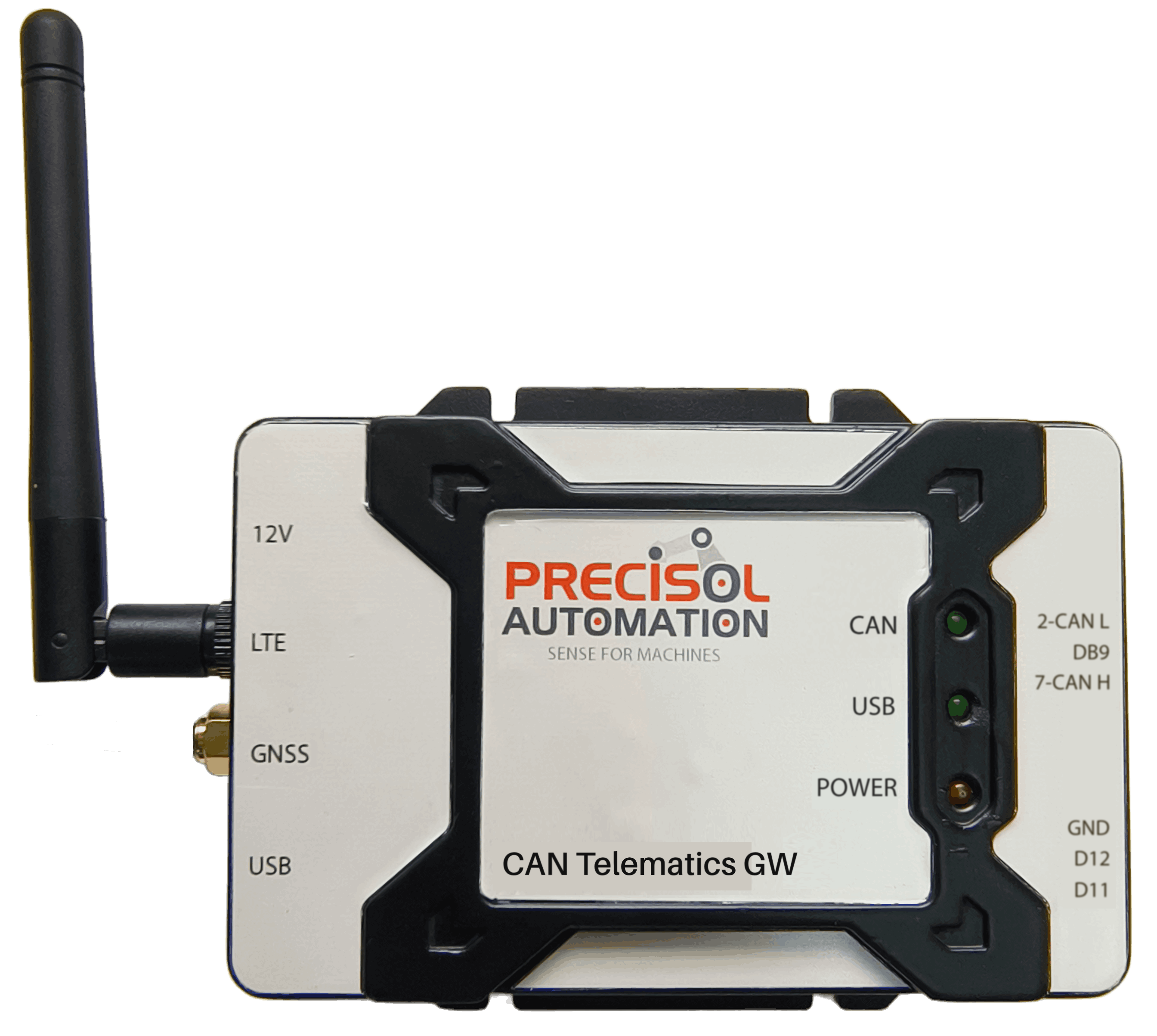
The customer sought a robust, flexible, and powerful solution to bridge the gap between their complex fleet and their centralized management platform. The solution selected was the Precisol Automation CAN Telematics Gateway, a purpose-built device designed for demanding industrial and automotive applications.
Real-Time Data Acquisition and Decoding: The core of the solution lies in the gateway’s ability to interface directly with the heavy truck's CAN 2.0 bus. Unlike simple diagnostic readers, the Gateway is configured using the vehicle-specific DBC (Data Base CAN) file. This is crucial as it allows the device to not just capture raw CAN frames, but to instantly decode them into meaningful physical values: engine temperature, hydraulic pressure, transmission status, brake wear, precise fuel consumption rates, and hundreds of other parameters. This process ensures accurate and normalized data, regardless of the truck's make or model, solving the critical challenge of data variability.
- Robust Cellular Connectivity and Secure Cloud Integration: Leveraging global LTE CAT 1 cellular connectivity, the Gateway immediately transmits this rich, decoded data stream to the customer’s cloud-based fleet management system (or the integrated PreciCloud dashboard). This ensured real-time visibility, allowing fleet managers to view key performance indicators (KPIs) and operational status of any truck, at any time. For scenarios where cellular connectivity is intermittent, the device’s internal MicroSD storage (up to 32GB) acts as a critical buffer, guaranteeing data integrity. The 100% power-safe data logging feature ensures no file corruption during unexpected power cuts, a vital requirement for long-haul operations.
- Focus on Reliability and Scalability: The Gateway was designed with the robustness required for heavy truck environments, encased in a durable, IP40-rated enclosure. This physical robustness ensured the device would maintain functionality even under severe stress from constant vibration and environmental exposure. The solution’s Over-The-Air (OTA) firmware upgrade capability allows for remote maintenance and updates, significantly simplifying fleet-wide deployment and ensuring the system can adapt to new vehicle models or regulatory changes without requiring physical access to every truck. By implementing the CAN Telematics Gateway, the customer established a unified digital layer across their entire heterogeneous fleet, transforming previously inaccessible CAN data into continuous, actionable intelligence essential for heavy truck predictive maintenance telematics.
Results: Quantifiable Improvements in Fleet Performance
Within the first 12 months of full fleet deployment, the implementation of the CAN Telematics Gateway yielded profound, quantifiable results that redefined the customer's operational efficiency and cost structure.
- Reduction in Unplanned Downtime: By enabling true heavy truck predictive maintenance telematics, the customer achieved a 22% reduction in major, unexpected vehicle failures. The real-time fault alerts and trend analysis of parameters like oil pressure drops or increasing coolant temperature allowed maintenance teams to intercept minor issues before they escalated. This shift from reactive repair to proactive, scheduled maintenance was the single biggest factor in the significant drop in costly roadside incidents and the successful reduction of heavy-duty vehicle unplanned downtime. Service events were now grouped logically, minimizing time spent in the shop.
- Significant Fuel Savings and Efficiency Gains: The granular data provided by CAN bus data decoding for fleet efficiency empowered the customer to finally tackle the fuel consumption challenge. By analyzing parameters such as excessive idling time (duration and location), high-RPM operation, and coasting events, the fleet management team developed targeted driver coaching programs. This led to an average fuel efficiency improvement of 6.5% across the entire fleet within the first year, representing millions of dollars in direct savings. Furthermore, maintenance issues that indirectly caused poor fuel economy (e.g., sticking brakes or sensor malfunctions) were quickly identified and corrected.
- Extended Asset Lifespan and Lower TCO: The improved diagnostic monitoring allowed the customer to optimize the lifespan of critical components like engines and transmissions. By operating assets within their optimal performance envelopes and scheduling component replacement based on actual usage metrics (rather than generic time-based rules), the customer extended the expected operational life of key assets by an estimated 10%. This lowered the Total Cost of Ownership (TCO) per vehicle and improved resale value.
- Enhanced Regulatory Compliance: The secure, time-stamped, and globally unique data logs provided by the Gateway ensured accurate records for mandated maintenance reporting and compliance with hours-of-service regulations (when integrated with other systems). This streamlined auditing processes and reduced administrative overhead, adding another layer of operational efficiency to the organization.The adoption of the CAN Telematics Gateway marked a fundamental paradigm shift for our customer, transforming their fleet from a collection of isolated assets into a network of transparent, data-rich operational units. By harnessing the power of the CAN bus, they secured a competitive advantage built on reliability, efficiency, and intelligence.