Driving Digital Transformation with Edge Computing – Utilizing the Precisol RS485 Modbus Gateway for Predictive Machine Health Monitoring
This case study details the deployment of the Precisol Automation RS485 Serial IoT Edge Gateway in a high-volume manufacturing environment to transition from reactive to predictive maintenance for critical production assets. The solution was strategically implemented to leverage industrial 4-20mA sensor data logging using LTE gateway and to enable implementing edge computing for vibration and temperature anomaly detection in manufacturing.
Introduction: The Challenge of Unplanned Downtime
A leading manufacturer in the automotive parts sector faced a significant operational challenge: the high cost and disruption caused by unexpected machinery failure. The Client relied on rigid, time-based preventative maintenance (PM) schedules for its essential assets, including high-speed CNC machines, extensive conveyor systems, and large electric motors. This method was inefficient, leading to unnecessary maintenance on healthy equipment while failing to prevent catastrophic failures that still occurred between scheduled checks.
The financial burden was substantial, primarily due to: (1) High Unexpected Downtime, with a single motor failure costing an estimated $10,000 per hour in lost production for up to eight hours; (2) Inflated Reactive Maintenance Costs stemming from the need for emergency labor and expedited parts; and (3) Critical Data Silos. Essential machine health data—specifically vibration, temperature, and power consumption—was trapped within legacy RS485 serial interfaces or accessible only via raw 4-20mA analog signals. There was no direct, scalable, or cost-effective path to relay this data to the corporate cloud platform for analysis. The Client’s objective was to implement an industrial IoT solution that would enable real-time condition monitoring, eliminate catastrophic failures, and establish a true predictive maintenance regimen.
The Solution: The Precisol RS485 Serial IoT Edge Gateway
After evaluating several Industrial IoT (IIoT) options, The Client selected the Precisol Automation RS485 Serial IoT Edge Gateway. The device’s technical specifications directly addressed the infrastructural hurdles the manufacturer faced. The solution was chosen based on four critical capabilities:
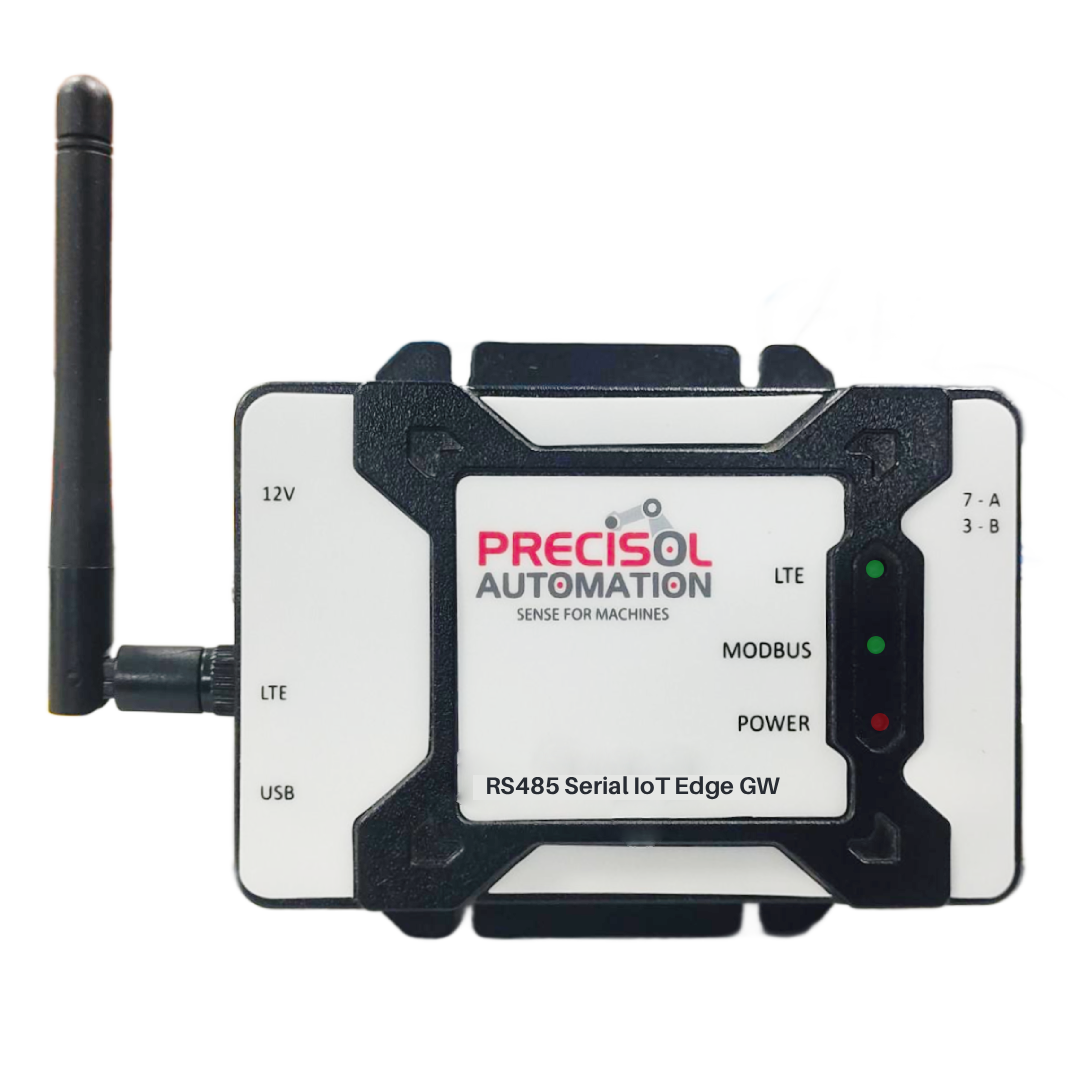
- Protocol Conversion: The gateway excels as an RS485 Modbus gateway for predictive machine health monitoring. It effortlessly translates data from legacy RS485-based sensors (using protocols like Modbus RTU) into industry-standard cloud protocols (MQTT/HTTP), making data instantly consumable by the existing enterprise analytics platform.
- Sensor Compatibility: Crucially, the gateway includes x2 high-resolution 4-20mA analog inputs (16-bit). This feature was vital for integrating existing, dedicated vibration and bearing temperature sensors that relied on the standard industrial 4-20mA current loop output.
- Durable Design and Connectivity: Featuring an industrial IP40 rated enclosure and a wide operational temperature range of -40°C to +85°C. The integrated LTE cellular connectivity simplified deployment by eliminating the need to install new Ethernet infrastructure across the large facility.
- Edge Intelligence Capability: This was the most compelling feature. The device’s ability to execute logic locally allowed engineers to set pre-defined thresholds and conditions. This meant that only actionable data—specific anomalies or alarm events—would be uploaded, significantly minimizing cellular data usage and reducing the processing load on the cloud infrastructure.
Implementation and Architecture: Industrial 4-20mA Sensor Data Logging
The implementation focused on the 30 most critical and failure-prone assets within the facility. The architecture was designed to integrate both legacy and new sensor types using the gateway’s versatile input options. The data acquisition strategy utilized both RS485 and 4-20mA inputs:
- Vibration and Temperature Data: For each critical motor, a combined vibration and temperature sensor was installed, each providing a 4-20mA output. These analog signals were wired directly into the Precisol gateway's high-fidelity analog inputs. This successfully enabled industrial 4-20mA sensor data logging using LTE gateway.
- Power and Energy Data: Existing power meters that monitored motor current, voltage, and power factor were already Modbus-enabled. These devices were daisy-chained onto the gateway’s RS485 port. The gateway acted as the Modbus Master, efficiently polling data from up to 10 serial devices on a single line.
Deployment was accelerated using the vendor’s specialized tools. The PreciCon Tool allowed remote configuration of the devices, including defining Modbus register maps and accurately scaling the parameters for the analog inputs. Subsequently, the gateways were configured to communicate via MQTT to The Client’s analytics cloud. The PreciCloud dashboard provided an initial verification point to confirm data streams, manage over-the-air (OTA) firmware updates, and supervise device health remotely.
Implementing Edge Computing for Anomaly Detection
To optimize data efficiency and establish a truly predictive system, The Client heavily leveraged the gateway's integrated Edge Intelligence. This local processing was crucial for avoiding the cost and complexity of transmitting high-volume, repetitive 'normal' data. Engineers programmed specific logic rules directly onto the device, effectively implementing edge computing for vibration and temperature anomaly detection in manufacturing:
- Vibration Logic: An immediate data burst and SMS/Email Alert was triggered if the Vibration measurement (from the 4-20mA input) exceeded a critical threshold of 0.8 IPS (Inches Per Second) for three consecutive readings.
- Temperature Change Logic: If the Bearing Temperature exceeded $95^{\circ} ext{C}$ or the rate of temperature change was greater than $5^{\circ} ext{C}$ per hour, the gateway would automatically switch its data reporting interval from a long 1-hour cycle to a critical 1-minute cycle until the condition cleared.
- Machine Status Logic: If the Motor Current dropped to 0 Amps, the gateway would register a 'Machine Shutdown' event and pause continuous data upload until current resumed.
This sophisticated local processing filtered out approximately 95% of routine data. Only actionable data points indicating impending failure or status changes were transmitted over the LTE network, drastically reducing data transmission costs and ensuring that cloud data scientists focused their resources exclusively on high-priority, actionable alerts.

Results and Impact: Achieving Measurable ROI
Within the first six months of operation, the transition to a predictive maintenance model using the Precisol RS485 Serial IoT Edge Gateway yielded substantial and measurable returns. The core outcome was the transformation of maintenance operations:
- Unplanned Downtime for the targeted assets was reduced by over 88%, dropping from an average of 35 hours per quarter to less than 4 hours per quarter.
- Reactive Maintenance Events saw an 85% reduction, decreasing from 8-10 per month to just 1-2.
- The ability to accurately forecast asset failure using vibration and temperature data, reliably streamed via the RS485 Modbus gateway for predictive machine health monitoring, allowed the team to identify bearing failures 3-5 days in advance. This allowed costly emergencies to be converted into planned, scheduled interventions during off-hours.
- Optimization from the Edge Intelligence feature resulted in a projected 90% reduction in cellular data costs per gateway compared to a simple continuous logging approach.
The deployment of the Precisol RS485 Serial IoT Edge Gateway provided The Client with a robust, scalable, and intelligent bridge between its critical operational technology (OT) sensors and its enterprise information technology (IT) cloud environment. By leveraging the device’s support for legacy RS485 Modbus, high-fidelity 4-20mA inputs, and powerful edge computing capabilities, the manufacturer successfully executed its digital transformation strategy, resulting in a documented and substantial increase in operational efficiency and a dramatic reduction in the cost associated with unplanned equipment downtime.